I have been trying to put together this review of Taipei Story for days now because I have so many feelings. It’s been a whirlwind and I wanted to make sure I was fully prepared to weigh in and share my thoughts on each of the elements so here we go – maybe an even longer review than for Babel? Keep reading this book review of Taipei Story for my full thoughts.
Summary
College freshman Lily Chen is off to spend the summer in Taipei at an intensive language program like so many Chinese American students before her, hoping to connect with the culture she inherited but never fully understood. But a promising start quickly unravels. Her classes are grueling, her roommate is driving her insane, and a reckless trip to the hot springs with a guy she barely knows soon has her classmates viciously gossiping. She feels adrift, a foreigner in a country she thought would feel like home.
Then shocking news Lily’s grandfather has passed away. The loss forces her to grapple with now-unanswerable questions about her family history. As Lily grieves, she’s drawn into a journey of self-discovery—piecing together memories, stories, and silences over a series of hilarious and devastating attempts at connection.
Review
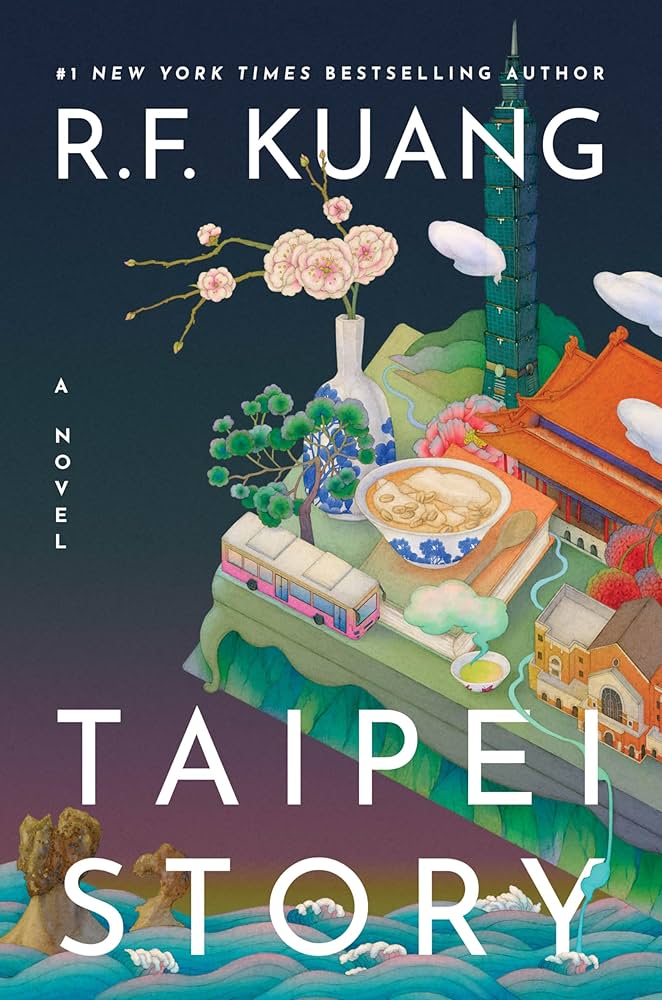
(Disclaimer: I received this book from the publisher. This has not impacted my review which is unbiased and honest.)
I have a whole host of feeling about Taipei Story ranging from deep resonance, to confusion, to windswept, to disappointment. It’s been a heck of a journey to even get to writing a review. I want to start off with what really resonated with me and also is very present in the beginning half of the book as well – the language learning. As a transracial adoptee, I’ve always felt like an imposter as people come up to me and speak to me in – what I presume – is Mandarin and then I have to say sorry and “I’m adopted”. And their reaction always leaves me with mixed feelings of grief, anger, and frustration. Seeing Lily’s journey with learning Mandarin and her struggling with imposter syndrome resonated with me deeply. It reminded me of people who told me I must have the tones in my head of when I heard it as a baby.
Heritage and Language
And said I’d pick it up right now. It resonated with how I felt growing up in my family as the only Asian and feeling like an imposter among them, but also in the US to belong so visually to a culture I had barely any roots with. Taipei Story reminded me of those moments where I thought, “do I learn Mandarin or is that only caving to what I think I should do, what I think would alleviate my guilt, avoid that awkwardness”. And it’s continued this discussion as I talk to friends and their own relationship to being Asian American in the US. So Taipei Story reached into that part of me and let me learn how it was for Lily as she navigates her family past and these layers of being an imposter syndrome, an immigrant multiple times over, and how one navigates assimilation and keeping the past alive.
Do we continue to tell the stories of how it was for us or do we forget to mention it until we are asked point blank? These pieces of Taipei Story at the beginning, really made me think about my own decisions as Lily navigates learning about her past in an effort to communicate with her grandparents. She views language as a tool, a bridge, a way to connect, but what happens if that connection disappears? What if we find not just a tool we can use, but something more difficult? A new way of thinking and relating? You can tell Kuang is interested in language as the first half really delves into the grammar, into those language frustration and experiences one might experience in a full immersion language learning program.
Language Learning
I did one of those and it brought back memories of the mind numbing exhaustion, the constant eye strain, the feeling of starting and stopping, and also feeling like the way I related to the world was shortened. In some ways, it became simpler, but as an adult learner, it also felt like I was losing a piece of who I was. I became someone else who had to re-think how I thought. If you’ve ever done a language immersion program, I’m sure you’ve had similar experiences and seeing Lily develop her skills and her ability throughout Taipei Story was an interesting experience. I related to how she wonders if being bad at Chinese also means we are bad at the act of being Chinese. That was a moment where I felt some pretty large emotions. I also found myself wondering if I would find pieces of myself if I went back and visited.
I visited Beijing as a teenager and fully expected to feel this deep re-connection. Similarly to Lily, I expected to have this tie which transcended words and was almost instantaneous. The idea of “being homesickfor a place you had never been”. You wonder if there’s this inherent understanding that will be given to you. And for Lily, and me, you realize that the nuances of identity means it’s almost impossible for you to find one which fits. Sort of like with Goldilocks. We find ourselves consistently trying to find the one which will feel like home. Might we have kinship just because of a shared heritage? Not even a shared birthplace, but maybe just an appearance, a set of stereotypes? These themes were developed the most throughout Taipei Story and they were unequivocally my favorite.
Side Characters
However, I felt there was a lack of depth in the side characters. Not only in their characters as individuals, but also in how they related to Lily. In Taipei Story we see a few notable side characters – mainly her family – but also her roommate, a potential love interest, and other students. I felt that the most attention was, rightly so, given to her family. Her grief with the death of her family member was piercing and I related to this numbness acutely. It’s one of the strongest moments for Lily’s character – in my opinion. I have felt that in a few of Kuang’s past projects, there’s been a bit of emotional disconnect, but as Lily evolves her relationship with her family, and her mother, it connects more than before.
I can’t say the same for the other side characters. I felt that they were just there for what we needed – which could have been a side effect of Lily’s own self-minded narration – but even her feelings towards them or their actions didn’t resonate as much as I would have liked. I would have liked to see more with her relationship with her roommate towards the end. It feels a bit shallow considering how much it impacts her especially within her grief. They seem to orbit Lily’s life and while they could be interesting point for her own character growth or introspection, Lily doesn’t do much of that within Taipei Story.
And the romantic relationship is another element which is almost told from a distanced slice of life style. It has these threads which would be interesting to pull on which Lily barely navigates. As readers we are left to ruminate on Lily’s experiences and draw our own conclusions, but when Lily herself fails to do so, it feels like a missed opportunity.
Subtlety
There’s been a lot of discourse about reader response while reading a book, how much questioning one must go into while reading, and the job of an author. Even so, I felt like I was missing some resolution with Lily’s character in some aspects. I’ve mentioned the side characters, but also we have the same issue for me with the potential relationship character. Much like in Yellowface in the latter half of Taipei Story, Kuang seems to be asking questions about authenticity and intention. We have multiple characters who are learning Mandarin for their own reasons and Lily compares these experiences to her own. She feels so much like an imposter syndrome that she wonder about their motivations and own journey.
We also have a different side character who Lily sort of questions as she gives a presentation about an identity she has researched, but not experienced. There are some comments here from that character about queer identity which even Lily thinks are Olympic levels of absurd and reach. Only experienced through a lens. One naturally makes the connection to Lily herself as she wonders about the lenses of her own potential appropriation of learning Mandarin in Taiwan not China. I thought this was an interesting element of Taipei Story and certainly one that is given more care and introspection. On the topic of references and subtlety we have the mention of Israel. I have done more research than I expected for Taipei Story – unlike in Katabasis – and I feel that we do more questioning about this than Lily does. The fact that the pianist receives more respect and fame than the other performers she sees at the concert halls over the coming weeks is certainly mentioned.
The Pianist
But Lily herself never really questions it. I understand that books can spark conversations and research, but I think to reinforce that idea, the character themselves must also question to. They can have an experience, begin a question, and then continue, but the fact is that Lily doesn’t really do the bulk of the questioning we have done. The reference seems out of place and while I can see that it might be intending to spark this conversation, I think more evidence within the text would be required to feel the weight of this observation and the questioning required. I’ve seen interviews which reference this and talk about Lily’s experiences as an Asian American and the government’s own political affiliations.
But I feel that it’s only symptomatic, to me, of the other ways in which Lily doesn’t advance her own character development – similar to the side characters. And it brings me to the fact that I did not enjoy the latter half of Taipei Story as much as I did the first half. There were elements that really shone through – like the grief – but even if readers aren’t given a cookie cutter sense of resolution in all aspects, I was missing the character growth as a whole from Lily to capture that same obsession I had after finishing Babel.
(Disclaimer: Some of the links below are affiliate links. For more information you can look at the Policy page. If you’re uncomfortable with that, know you can look up the book on any of the sites below to avoid the link)
Overall,
I had no idea what to expect with Taipei Story. Ever since Katabasis, I wasn’t sure what to expect. I enjoyed Yellowface as someone who read it at the right time as I was leaving publishing. There are some pieces of Taipei Story that I absolutely loved. That I’ll be thinking about and talking to with other friends. But there are also elements that left me feeling a bit disappointed and frustrated. Find Taipei Story on Goodreads, Storygraph, Blackwells, & Libro. fm.