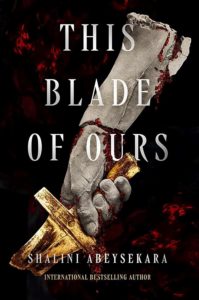
I had EVEN more questions after finishing This Blade of Ours and wanted to see if Shalini was willing to answer them. And she was! So here are even more of my burning questions after finishing this fabulous duology! Keep reading this blog post to see more of Shalini’s answers about This Blade of Ours.
Summary
Death isn’t finished with them yet.
Sarai believed the worst was behind her. However, months after exposing the government’s corruption in what has now been deemed “the Great Unravelling,” she faces scorn from citizens who preferred her and Kadra as the underdogs than victors. Worse, eerie omens rock the country: from a deadly plague outbreak to a sweeping madness that leave the afflicted ranting of an approaching reckoning. Accused of angering the gods, Sarai returns to the only place that can clear her name: Ur Dinyé’s frozen north. But among the secrets buried in its ice are Kadra’s.
Cursed with frightening, new abilities, Kadra struggles to protect Sarai against a land at odds with itself. When historical tensions worsen between the north and the south, a powerful religious order seizes control in the chaos, led by a man whose very voice can kill—Noceo bu Kader. Trapped between love and a crumbling country, Sarai and Kadra must outwit a power with roots as deep in fear as in cruelty. But the gods are always watching, and Sarai and Kadra may not escape a second time.
(Disclaimer: Some of the links below are affiliate links. For more information you can look at the Policy page. If you’re uncomfortable with that, know you can look up the book on any of the sites below to avoid the link)
Find This Blade of Ours on Goodreads, Storygraph, Bookshop. org, Blackwells, & Libro. fm.
Author Interview
The burden of truth and what it means to confront the truth we don’t want to see resonates in this series and specifically the sequel. What draws you to this idea of an individual creating stories and truths within their head as processing, healing, or protection?
To live is to tell yourself a story about living. What we want out of life, how we feel about what we’ve gotten, whether we think we had a fair shake, and if there’s anything we regret. The stories we weave inspire future wants, needs, hatred. We’re all an amalgamation of a set of fables, and the more I’ve tried to understand it, the more I see story everywhere.
In TBOO, I sought to explore some of the more prominent ways we use story.
Therapy is the untangling of false stories we’ve been told and trying to tell ourselves better, truer ones that allow us to move forward with hope instead of torment. TV and film reflect our obsession with stories and show which ones we relate to and make viral. Politicians use this innate love for story to craft false narratives. Lawyers use the same to sway a jury or judge.
Every one of these methods come to play in TBOO, because it always boggles my mind that every atrocity, every horrific erasure of rights has a story behind it with heroes, villains, a beginning, a middle, and a final goal of obliteration. Humanity will always boggle my mind.
Can you talk to us more about the Gods especially as they progress and develop in the sequel? What God is your favorite to play around with?
I loved writing those messy gods! Despite being loosely modelled on the seven deadly sins and virtues, I wanted them to feel larger than life and rather eldritch. Reason being that I didn’t think two pantheons of all-powerful gods would look much like humans or like us very much.
As fun as Wrath was, I loved playing around with Faragathe. She has such immense dislike for humanity, and I’m still not convinced that we don’t deserve it!
I’ve written portions with Death in another work, and he remains a hoot as well, so they’re both tied for first place!
We have this omniscient narrator which allows us to see Kadra and Sarai, did you ever have this drafted as a different narration style?
I debated on rewriting both books using first-person POV for the longest time. I’m still not sure if I made the right choice in having it in third-person limited.
It feels as though more and more readers are able to relate more to first-person POV, so I wince whenever I hear that third-person is falling out of favour. But it’s a pivot I’m making in future work, so stay tuned!
If you wrote an origin story for a side character in this book, who would you want to write and why?
I’m so torn between Anek and Cassandane. I think I’ll go with the latter because the Cassandane we meet is in her thirties and has had a long life dealing with a lot of nonsense. That forms much of the risk-averse Head Tetrarch she becomes, and I’d love to examine more of her fear and choices as essentially a female President in a misogynistic country.
Trauma and what we make of our situations and circumstances is a theme you really further developed in this sequel. Can you talk to us about how you use book two to really develop these themes for our main characters?
Oh, heck yes!
I’m pretty open about the fact that I’ve spent a long time recovering from various external actions that gave me various disorders. As a result, trauma is unfortunately always going to be a part of my work. I have trouble writing a character without it, simply because I cannot imagine the experience life.
The worst part about having something happen to you that you never asked for and couldn’t control is that the aftermath still becomes your responsibility. You can either choose to sit at the bottom of the well life kicked you down, or you can stand up. But it’s never that easy, the social supports are simply not there, and people get tired of you talking about it after the first year. I’ve seen people who didn’t make it out of the prisons their heads became.
I’m loathe to put too much of myself into a book, so I took bits and pieces of my experiences and others and examined alternate paths in TBOO.
Sarai has been through hell but remains hopeful and optimistic, a mindset that is sorely tried by a populace that’s determined to denigrate her for the simple fact that she’s a woman in power.
Kadra has also been through hell and internalized that torment into becoming a vigilante with only one line he won’t cross: killing an innocent. But he has very high standards for what constitutes an innocent. (As many Metals Guildsmen can attest).
Both are determined to ensure that no one else knows the pain they have. But that grows harder and harder when the very people they’re trying to protect are determined to cause them pain. For the first time, Kadra is forced to choose between love and country and perhaps erasing the one line that’s kept him human so far.
Noceo is equally fuelled by trauma but has become one with it and inflicts it on others. Partially because he believes their stupidity merits such treatment, partially because he survived and so should they, and partially because, after years of subjugation, he believes his needs are all that matter. That’s a tempting mindset for Sarai in particular because she’s been so sacrificial for a fickle populace.
Then, we’ve our final villain who sees the demons of their past in every easily manipulated citizen and wants them to pay for the harm they cause.
I wasn’t aiming to proscribe a certain way of handling trauma but for these characters to have a dialogue. I hope their emotional journeys feel real and like they were handled with care!
Love is obviously a huge theme in the books, but here you develop the idea of love and self-acceptance. It reminds me of that saying where you can’t expect anyone to love you if you don’t love yourself. Can you explore more how this saying and this theme meets our characters at the beginning of book two?
Being in love doesn’t heal trauma or insecurity. If anything, it can make it worse because it shines a spotlight on what you think you deserve and what you fear losing.
Sarai finally has the sort of love she’s yearned for her whole life: someone who truly sees her for who she is, doesn’t require her to change, and would do anything for her the way she would for him. But now, she’s deeply conscious of how little she feels she can offer him. She isn’t very powerful magically or socially. She’s no great beauty. And she’s of no use politically, especially now that people believe she’s brought the gods’ wrath on the country for resurrecting him.
Meanwhile, Kadra’s in the same boat. For all his magical prowess and power, he can’t shield Sarai from slings and arrows, is Godstouched to boot, has to watch her humbling herself before the public and the Elsarian Order’s Inquisitors to protect him, and fears that she’ll be done with him once she learns the truth of his past.
Both see their troubles as internal failings because they don’t believe they deserve what they have. Part of that is insecurity, true, but it’s also a brutally, depressing acceptance of how the average person would react to them. Luckily, neither are average people, so we know they’ll be more than fine, but the struggle felt true to the characters as we find them at the start of TBOO.
For all the darkness in this book, there’s a lot of empathy, trust, and firm conviction in caring even when the world doesn’t seem to deserve it. Sarai and Kadra find that love might expose your greatest wounds, but it’s also what can heal them. Alas, it can’t mend a fractured country on its own. But it’s a damn good start.