Yesteryear is a book that has broken out of the book space. It’s a story about traditions, about creating images, and fame. It’s one of those books that had me thinking about a lot of things while reading and I ended up finishing 40% in one sitting. Keep reading this book review of Yesteryear for my full thoughts.
Summary
My name was Natalie Heller Mills, and I was perfect at being alive.
Natalie lives a traditional lifestyle. Her charming farmhouse is rustic, her husband a handsome cowboy, her six children each more delightful than the last. So what if there are nannies and producers behind the scenes, her kitchen hiding industrial-grade fridges and ovens, her husband the heir to a political dynasty? What Natalie’s followers—all 8 million of them—don’t know won’t hurt them. And The Angry Women? The privileged, Ivy League, coastal elite haters who call her an antifeminist iconoclast? They’re sick with jealousy. Because Natalie isn’t simply living the good life, she’s living the ideal—and just so happens to be building an empire from it.
Until one morning she wakes up in a life that isn’t hers. Her home, her husband, her children—they’re all familiar, but something’s off. Her kitchen is warmed by a sputtering fire rather than electricity, her children are dirty and strange, and her soft-handed husband is suddenly a competent farmer. Just yesterday Natalie was curating photos of homemade jam for her Instagram, and now she’s expected to haul firewood and handwash clothes until her fingers bleed. Has she become the unwitting star of a ruthless reality show? Could it really be time travel? Is she being tested by God? By Satan? When Natalie suffers a brutal injury in the woods, she realizes two things: This is not her beautiful life, and she must escape by any means possible.
Review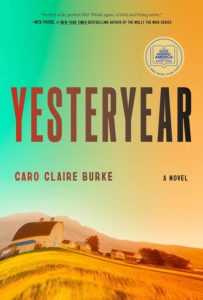
I can see why Yesteryear has taken off. In many ways, it’s a story about radicalization but not in the traditional reading of chat boards, but one about the ways we find ourselves in these cages. Yesteryear very much is about the cages we make ourselves. The ways we try to escape, survive, persevere and end up creating gilded walls of our own. A problem for another day. It’s about the creation of an image, of a person, a family, a future, a past. It embodies the idea of going back to the ‘golden days’, to the days which propaganda has us believing were the better days. And it’s also a story about fame.
Social Media and Image
While it’s certainly far from perfect, it made me think and I finished it in a few days. The first thing that really stuck out to me was the way Yesteryear talks about fame. How we can deal with the hate comments, the vitriol, the jealousy, but how the love almost weighs more. The weight of being loved, being looked up to, and how it almost becomes more dangerous than the hatred. It’s all about the shift, the dramatic line between love and hate, which can turn on us. For Natalie she has to navigate creating the image of herself and her family.
The perfect wife who makes her own soap, takes care of her multiple children with ease, and still manages to feed the chickens and make cakes. Yesteryear is about how these images are created from the ground up with blood, sweat, and tears. But it’s also about the invisible figures who make these lives, these images possible. I actually think that’s one of the ways Yesteryear could have gone a bit further in its discussion – or lack of – about ethnicity and some of the language choices of Natalie. Considering the tone of the book and the praise, I had expected some sort of meaningful comment on it rather than just nothing.
Her Own Four Walls
And while we might not like Natalie, I empathized with her struggle. The way in which she seems to have it all – the money, the fame, the perfect family – but she doesn’t have control over her finances, still gets frustrated with her children, and has to be married to Caleb. What has come as coping mechanisms, turns into privilege and opportunity, but all with thorns. This perfect image has turned against her in some ways as she is at the mercy of the walls of her own making and the internet. Forced to constantly perform, to know nothing she says is truly her own, and to be unsure of her own future.
Please give my husband a spine. I’m tired of him needing to borrow mine.
Yesteryear doesn’t allow an easy victim and perpetrator discussion. It doesn’t let Natalie off the hook for how she’s been complicit, how she’s fallen into her own traps. With small snippets into the past, which felt a bit like whiplash at times, we can see the cracks forming before they were even dry. It reminded me of the Fight, Flight, or Fawn reaction. Even more so, part Four emphasizes the way she has embodied the past. Natalie struggles to figure out how much of herself she has to erase in order to survive.
Conclusion
There are layers upon layers to Yesteryear. And yet a few added layers that should have been there. Overall, I ended up devouring Yesteryear in a few days. I totally understand why it’s become so popular in a world of propaganda to celebrate the ‘old days’ while also wanting to have clean water from the tap. A book which explores the trad wife surge, the creation of social media images and figures, and more. It’s certainly a book I think you should read for yourself. Find Yesteryear on Goodreads, Storygraph, Blackwells, & Libro. fm.