If you’ve been following me for a while now, you will know how much of a big deal this review is. I’ve been following Kuang before The Poppy War came out and so being able to read Katabasis early is a dream come true. And WOW do I have thoughts! Keep reading this book review of Katabasis for my essay long thoughts.
Summary
Alice Law has only ever had one goal: to become one of the brightest minds in the field of Magick. She has sacrificed everything to make that a reality—her pride, her health, her love life, and most definitely her sanity. All to work with Professor Jacob Grimes at Cambridge, the greatest magician in the world—that is, until he dies in a magical accident that could possibly be her fault.
Grimes is now in Hell, and she’s going in after him. Because his recommendation could hold her very future in his now incorporeal hands, and even death is not going to stop the pursuit of her dreams. Nor will the fact that her rival, Peter Murdoch, has come to the same conclusion.
Review
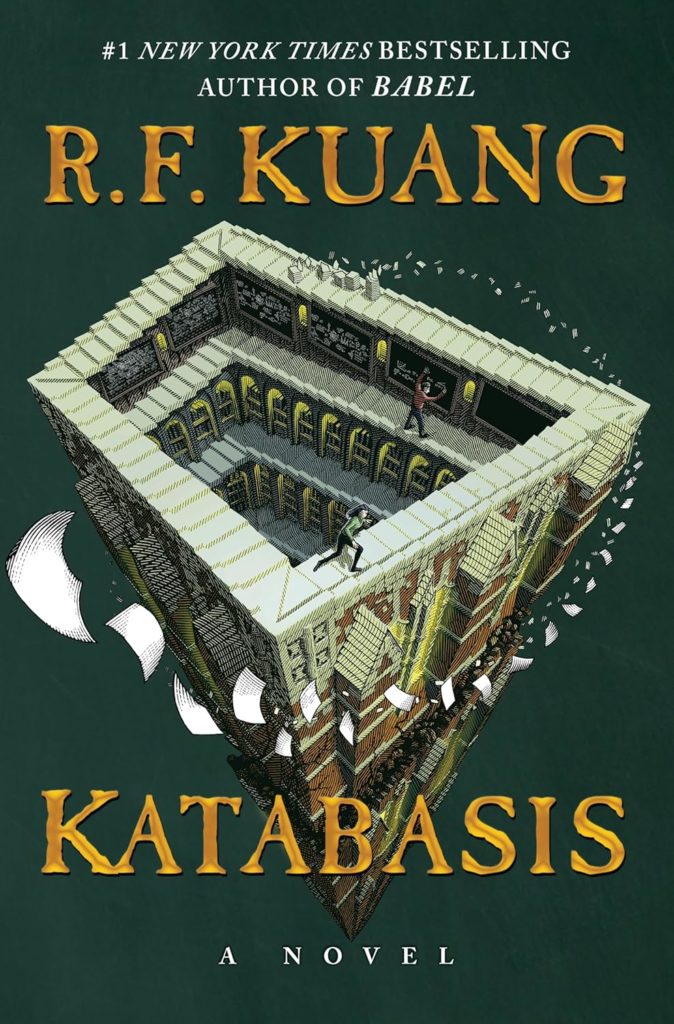
(Disclaimer: I received this book from the publisher. This has not impacted my review which is unbiased and honest.)
Let me first say, I don’t think I’ll ever be able to write a cohesive book review of Katabasis for my full thoughts. Like most books, my feelings about this book are a product of the books I read before this, my appreciation for Kuang books in the past, and my own feelings on academia in general. As a former academic, reading Katabasis reminded me of one of the reasons I left academia. Not only is there this distance that can be felt between academia and the very real people it impacts – see Babel for those feelings – in Katabasis we see the corruption of power, the use of authority, and the ways in which academia does not protect those it says to teach.
Academia and Abuse
Not only does it actively cover up and remain complicit in actions of individuals, departments, and oftentimes institutions as a whole, but it does not even protect its own students. Academia is not a position of wealth. It publicly does not treat graduate students well and as someone who was thinking about academia, the job security, and the ‘security’ within the field, I know this all too well. So in many ways, Katabasis is a direct response to that. However, for those who are experienced with this or even graduate students themselves, they’re all too familiar with the grind for no reward, the ways they don’t often receive the credit they deserve, and the ways they are forced to compete for scraps and the brief glimmer of a secure future.
Katabasis takes these experiences and grounds them not in classrooms, but in Hell. Aren’t they the same anyway? It examines what happens when we are pushed beyond our breaking point. What happens when our genuine passion for something is not enough anymore to be a ‘good’ student or scholar? Academia, and like many other cerebral fields or even the arts, can force people to push themselves to the brink, to accept the idea that suffering produces greatness. Except what they don’t often acknowledge is the cost of this greatness. And that’s where Katabasis begins. It begins at the moment where the cost of the pursuit of greatness has not only impacted Alice, but also her advisor.
The Cost of Greatness
Yet with academia, and I can see other parallels to other fields, we who engage are taught that it will all be worth it in the end. That the abuse, the late hours without pay, will yield us a position, a paper, a credit, a future. We become almost complicit in our own suffering and our acceptance of the suffering in this toxic relationship of the ‘pursuit of greatness’. Now you meet Alice who exists at this epicenter. She’s too willing to turn herself inside out to become Great. To have this pure idea of knowledge which will be worth it all in the end. She believes discovery is the joy itself. And she’s so willing to do whatever it takes, bend herself into whatever shape, give up whatever she has to do, in order to do it.
Alice is envy, obsession, and embodiment. She is obsessed with greatness, and doing whatever it takes, which is fueled by her envy. And yet at the same time, what she really wants is to become the Greatness she sees around her. To embody the success she sees and become it.
What follows in Katabasis is a story about dismantling this toxic relationship between the idea that you have to suffer for greatness. That ambition requires a perpetual hollowing out of ourselves. The idea that it demands this purist isolation from the things that ground us in life, all so we can pursue these kernels of truth. We are supposed to suffer and say thank you. We are supposed to revere the ground upon which they walk because if don’t see the greatness of those above us, then we start to question the value of it all. If they’re not so great, why do we subject ourselves to this at all?
The fantasy setting as metaphor to discuss this is the thinnest whisper of a veil as most of these discussions have little to do with magic. The main vehicle of magic is the facilitation of Alice’s own discoveries not really of knowledge, but of herself and her own limitations while in Hell.
Philosophy and Theory
Katabasis is theoretically dense at time. There’s a great deal of the book dedicated to logic as Alice not only is deeply into academic theory and magic theory, but also many of the people they meet in Hell are similar as well. Without spoilers, academic theories and questions which are explored are rebirth, the importance of forgetfulness, and what it means to escape Hell. This may be obvious considering they descend into Hell, want to break their advisor out of Hell, and also come into contact with many souls who are also trying to escape this space in any way or another. But Kuang throws us headfirst into the theories behind it.
Romance
In terms of the romance aspect, as this is probably the most ‘romantic’ of Kuang’s works to date. This is another element of Katabasis as Alice comes to terms with the idea that the pursuit of knowledge does not have to come from isolation in a setting which almost demands rivalry and competition. Peter and her become rivals within this setting because of academia and the ways in which their achievements are constantly compared. It feeds not only into their views of each other, but also of themselves as they seek to be better.
For me, while I did enjoy the romance within, I do feel like it was the most shallowly developed element in Katabasis, mostly because I wanted a bit more of Peter in terms of development. Oftentimes we get caught up in the swoon, but to feel the changes in their relationship and the ways in which their relationship could change as being mirrored by Alice’s changes, I wanted a bit more towards the end.
Pacing & The End
Katabasis as a plotline, comes into its swing later in the book when the threads, and the tension, finally come to a head. I would argue that the momentum also picks up when most of the theoretical foundation is laid. Until then, I can see how it can be plodding or difficult to get through. You have to enjoy theory, enjoy picking apart an idea, and twisting it around in your mind at the same time as Alice – and Peter – because that’s what largely makes up their character.
At times, it can lean a bit heavy handed on the academia, and if you don’t want to have this feeling of being back in the theory trenches, this might not be for you. I will say that towards the end as the theory patters off, I was frustrated with a few theories that I wish had a more resounding conclusion considering the weight and depth they were given in the beginning.
(Disclaimer: Some of the links below are affiliate links. For more information you can look at the Policy page. If you’re uncomfortable with that, know you can look up the book on any of the sites below to avoid the link)
Overall,
But at its core, Katabasis is a book about the journey of the self. In many ways, our characters have to be broken down to be built back up again. I think that’s true for Alice who we all think begins in this state. She’s just decided she has to go down to Hell to save her advisor, how much lower can we go? But you just wait and see. For Alice to even think about returning upwards, she’ll have to figure out what she’s actually willing to sacrifice. I’m not sure if Katabasis is for everyone. I deeply enjoyed Katabasis.
I felt like I was able to fully immerse and while some moments felt like being a classroom again (which I was glad to depart from), I enjoyed the contemporary examination of Hell and the ties it established to academia. Too much of myself feels like Alice in her almost single minded pursuit of what she considers greatness. It’s just about what we think constitutes greatness and whether or not we allow other ideas of what greatness could be.
Find Katabasis on Goodreads, Storygraph, Amazon, Bookshop. org, Blackwells, & Libro. fm.