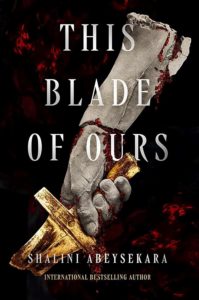
I am SO thrilled to be doing another interview with Shalini Abeysekara all about This Blade of Ours. This was one of my most anticipated sequela nd it 100% delivered. Keep reading this author interview to find out all my burning questions upon finishing!
Summary
Death isn’t finished with them yet.
Sarai believed the worst was behind her. However, months after exposing the government’s corruption in what has now been deemed “the Great Unravelling,” she faces scorn from citizens who preferred her and Kadra as the underdogs than victors. Worse, eerie omens rock the country: from a deadly plague outbreak to a sweeping madness that leave the afflicted ranting of an approaching reckoning. Accused of angering the gods, Sarai returns to the only place that can clear her name: Ur Dinyé’s frozen north. But among the secrets buried in its ice are Kadra’s.
Cursed with frightening, new abilities, Kadra struggles to protect Sarai against a land at odds with itself. When historical tensions worsen between the north and the south, a powerful religious order seizes control in the chaos, led by a man whose very voice can kill—Noceo bu Kader. Trapped between love and a crumbling country, Sarai and Kadra must outwit a power with roots as deep in fear as in cruelty. But the gods are always watching, and Sarai and Kadra may not escape a second time.
(Disclaimer: Some of the links below are affiliate links. For more information you can look at the Policy page. If you’re uncomfortable with that, know you can look up the book on any of the sites below to avoid the link)
Find This Blade of Ours on Goodreads, Storygraph, Bookshop. org, Blackwells, & Libro. fm.
Author Interview
One development in This Blade of Ours (TBOO) is the addition of brothers and the complexity of family. Can you talk about what it was like to create these characters, explore this new side of the past, and also delve into these difficult relationships of family?
Family is a complex thing, isn’t it? I wanted This Blade of Ours to be Kadra’s book the way This Monster of Mine was Sarai’s. That necessitated a deep dive into how this larger-than-life figure came to be, and there’s little that can scar a child as deeply family.
I was hoping for readers to understand what shaped Kadra’s worldview and developed the vicious instincts and cruel sense of justice we see in the first book. Painting what that childhood looked like was quite a challenge. I tried to do justice to his brutal circumstances without overwhelming the reader. Hopefully that balance translates well on the page!
Kadra’s family looked quite different in the first draft of TBOO—more characters, a patriarch who was still alive and rivalled Kadra for cruelty. There was a lot going on that had to be pared down to fit within a 430-page book. But the central ropes binding this family and their history were pain and a gnawing, nameless hunger resulting from years of childhood abuse. I won’t spoil too much of what happens later in the book, but I grew attached to both Kadra’s childhood compatriots. I chart every inch of the minds of my characters before I commit them to the page, but the imagination always finds a way to surprise! I grew increasingly torn over the sort of fate they deserved. Part of me wonders if I went in with too light a hand, and the rest of me wonders if I should have gone darker. I think the fact that I’m still thinking about it is probably a good thing! I hope that conflict rings bittersweet to the reader as it does for me.
Compulsion is a huge theme here and the idea of free will. Why specifically did you choose this magical power and how did you create the magic in this world i.e. bridging etc?
This book was very much a product of the time during which I wrote it. Globally, we were one-month after the US election. The worst sort of people had been emboldened to scale new heights of cruelty. Techno-feudalism rose loud and proud to claim the headlines. The law dropped every last guise to prove itself to be nothing more than a punitive instrument used by the wealthy to protect their assets. I think most of the world (those whose minds hadn’t been eaten alive by ChatGPT at least) had this horribly, crawling sense of a system they never had much control over to begin with, slipping from their fingers to slide into dark, dark times with nothing but outright war capable of stopping it.
The foremost question in my head for the people cheering on this madness was: why can’t you see what you’re doing?
Which then, translated to: if only there was a way to just make them stop.
That translated into the political turmoil Sarai faces in This Blade of Ours, where nothing she does is good enough for a populace that has already decided what is and isn’t true and spun narratives to suit their cherry-picked facts. Noceo’s power of Coercion is an amalgamation of the sort of drivel that politicians spew to grift their way into communities and sow lies and the sort of content that algorithms curate to encourage division. He compels but he doesn’t have to try too hard. Most of his victims were already eager to believe the lie.
Sarai believes that every constituent in the country deserves the free will to make the political decisions that they do, but that belief is sorely challenged when they consistently choose evil. Her battle with Noceo and his powers of compulsion reflect the inherent conflict within the idea of free will and how far it should extent when it takes away the rights of others.
Magic like Bridging was also borne out of real-world concerns. Around traffic. I would do anything to teleport at this point. (Come over, Mephistopheles! I have a Faustian bargain for you.)
As for the rest of the magic system, well that was me having a lot of fun! I remain utterly besotted by the magic systems of our literary greats and I’ll die on the hill that the bell system in Sabriel by Garth Nix deserves so much more love! The tiered runic system that I had in this duology (which I finally got to explore in the second book! A prayer in memoriam for all the magic cut from the first, please) loosely referenced Nix’s brilliant work while hopefully being simple and comprehensive for readers picking up the book after a long day at work.
Truth and the subjectivity of it has been long discussed in this series, but here as the idea of believing a truth day after day, of being confronted with lies and being made to believe they are truths, is another theme in TBOO. What draws you to the discussion of truth and specifically widespread ‘truths’ which are sold to us?
You can take the lawyer out of the courtroom but you can’t take the courtroom out of the lawyer! My former career and my autism have lent themselves to an obsession with “the truth.” I feel very strongly about honesty in all situations, understanding every possible nuance, and the long-ranging consequences of each facet.
I don’t believe I’m unique in this regard. I’d argue that the most belligerent conspiracy theorists (the regular people buying into it, not the Youtubers spewing nonsense they know to be lies) are those who fall in too deep while searching for patterns and meaning in our existence.
Still, truth has never been a convenient concept, but we live in a time where it’s being obfuscated, overwhelmed, and utterly decimated. Simple facts that should never be up for question are being spun into conspiracy theories so a few Youtubers and Tiktokers can get a third house. Conversely, there are routines that we believe to be necessary and concepts that have become normalized that should be questioned and go widely unchallenged. Ex: Why are corporations treated as separate legal entities with more rights (in practice) than people?
There’s nothing quite like fantasy to mirror reality’s absurdities, so I thought to litigate this dichotomy in a fantasy setting. I can’t tell whether that’ll make the book deeply unlikeable for hitting too close to home or whether the discussion will actually resonate. But the conversation feels necessary, and I hope that people join me in it.
You begin at what others could consider the end and delve into the messiness of power vacuums and struggles which are never over. What inspired this storyline or the general storyline for book two and how much did you know when you drafted TMOM?
Haha, I wish I could say that this was the plan from the start but it really wasn’t! TMOM was always meant to be a standalone, but you simply don’t say “no” when publishing offers you a two-book deal!
I had hoped to explore the world 500 years before Sarai and Kadra’s story, in a prequel called The Scourgemaster. (That’s coming out independently, next year!) However, the consensus was that they’d prefer a sequel. So, I began this exercise of imagining what came after the end, and the timing of everything else going on in the world shaped the conversations and questions that became central to this sequel.
Who was your favorite side character to create or spend more time with in this sequel?
Dalvia, hands down. I relate to her despair and anguish immensely. It was often hard for me to find some semblance of hope and optimism to write Sarai’s chapters, because I was going through so much at the time. Dalvia, however, came really easily.
Can you talk us through the process of your title creation and the patterns they follow, but also the meaning?
Oh, yay, I never get asked this! I try to drop Easter eggs into every single thing, so I consider my titles very carefully. Not just the book title but the chapter headers as well!
This Monster of Mine is pretty easy in the sense that it refers to Kadra as well as the central question of whether he’s as monstrous as Sarai fears. The initial title for the book was Monstrous, with a lot more darkness to the story, but I’m still very happy with what it became!
This Blade of Ours speaks to the sequel really being about Sarai and Kadra united against the very populace they had sought to protect along with new enemies. It also highlights the switch in TMOM being Sarai’s book, while this one switches to dual POV.
With respect to chapters, Sarai’s chapters have one-word titles. Kadra’s are all a few words. Part of it is that she pares things down to single concepts more often, while he’s awash in the grey. Funnily enough that’s exactly what allows her to see things clearer than he does at times in TBOO!
Final Easter egg: In both books I refer other works that I’m writing or planning to release. TMOM and TBOO both reference The Scourgemaster, and that book will reference another secret project! Clearly, I dream of my own MCU.
About the Author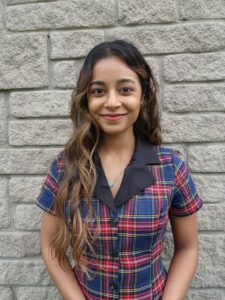
Shalini Abeysekara (she/her/hers) is the #1 Sunday Times bestselling author of This Monster of Mine. A former corporate lawyer, she uses fantasy to explore monstrosity, craft cynical MMCs who respect women, and center neurodivergent women reckoning with their place in a world that tells them they’re too much and not enough. When not writing, she games her life away and tries to make the perfect entremet. Most days, she can’t believe she’s an adult, and hope you don’t either.
Her debut dark romantasy duology, This Monster of Mine, is an Ancient Rome-inspired bloodbath of manipulation, deception, and forbidden love.
The sequel, This Blade of Ours, releases on June 30th in North America, and July 2nd everywhere else. Find the preorder campaign with 6 free prints and more HERE.
Follow her @shalini.writes on IG/ @shaliniwrites on Tiktok to be the first to hear about preorder campaigns, bonus chapters and more!