I am so excited to be able to feature this interview with the writers of Dead and Breakfast. This is one of my favorite reads so far of the year and I loved the mixture of coziness and mystery! Keep reading for the full interview with Rosiee Thor & Kat Hillis!
Summary
(Disclaimer: Some of the links below are affiliate links. For more information you can look at the Policy page. If you’re uncomfortable with that, know you can look up the book on any of the sites below to avoid the link)
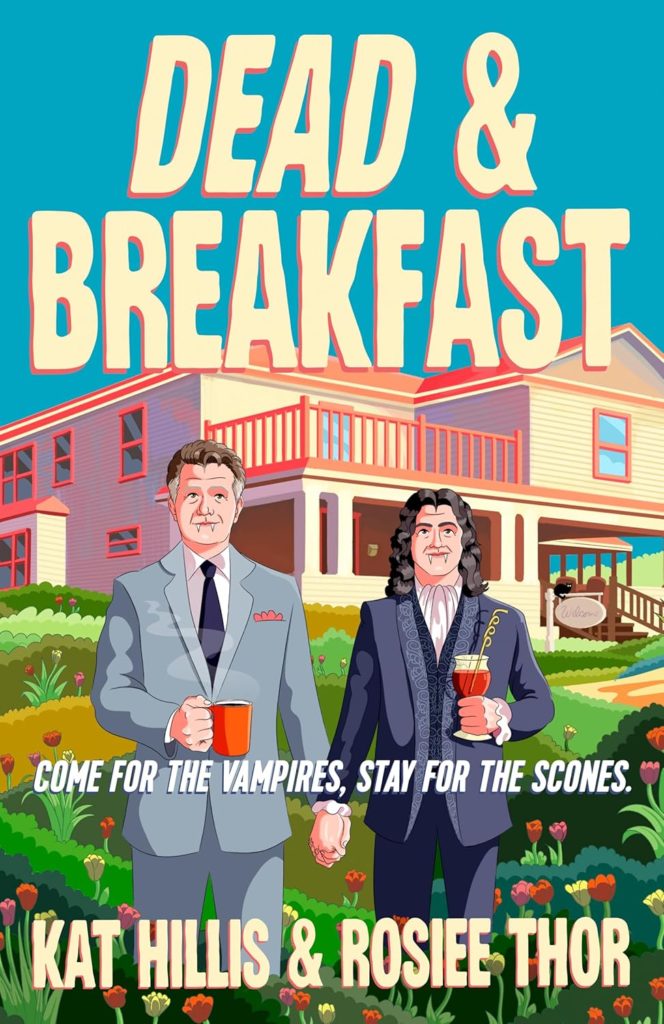
Married odd couple Arthur and Sal are totally normal. They wear sunscreen, not because the sun can kill them, but because even the undead need a skincare regimen. They eat garlic whenever they want, though it gives Sal indigestion. They can talk to creatures of the night, but only the raccoons that rifle through their garbage. Really, they don’t bite… except into delicious baked goods.
Ready to settle down and stay out of trouble, the two have opened a bed & breakfast in the idyllic, if not-so-paranormal-friendly, town of Trident Falls, Oregon. But trouble finds them when the mayor is discovered dead in their begonias with two puncture wounds in his neck. With the help of a werewolf barista, the elven town coroner, and a very human city manager, Arthur and Sal will need to prove they aren’t literally out for blood by catching a killer…
Find Dead & Breakfast on Goodreads, Storygraph, Amazon, Bookshop. org, Blackwells, & Libro. fm.
Interview
How did the co-writing process work? I know for everyone it’s a bit different how they approach the division of labor, dialogue, scenes, etc. What were some unexpected challenges?
Because we have opposite strengths and we live on opposite sides of the country, our process is a little strange. Kat loves the drafting process but hates revising, and Rosiee struggles with the blank page but loves the revision process. As a result, Kat, on the east coast, fast-drafts a chapter in the morning and then Rosiee, on the west coast, takes that chapter and revises it same-day. That way, we’re able to essentially do two drafts of a book at the same time. It’s a huge time-saver, plus we both get to do the part of writing that we like the most.
As far as challenges go, writing together is such a smooth process it’s hard to pinpoint any true struggles. We both love writing these books together so much–it sounds kind of cliché, but it really is a dream team setup. Technology has probably been our only real setback. Because we’re working in the same document, we have to make sure we aren’t working at the same time. Once, we accidentally had two versions of the book going at the same time because we didn’t double check with each other and we almost lost several chapters of work, but we found both versions in the end. Other than that it’s been pretty smooth sailing.
For the supernatural world of DEAD & BREAKFAST, you both tackle some vampire myths. How did you decide which myths to keep and which ones to toss out? Also what are some of your favorite vampire references in the book?
For the myths, we mostly went with Dracula rules, with some pretty fun variations. For example, our vampires aren’t all repelled by Catholic religious symbols–unless the vampire is themself Catholic. In this universe, vampires all share the same curse, but we had a lot of fun exploring the ways modern vampires would get around their limitations, especially when it came to soliciting invitations into people’s homes.
The book is full of vampire references because we’re total nerds, but also because we figure in a world that has both IRL vampires and vampire media, it would make sense that they’d have strong opinions about their fictional counterparts. We especially loved imagining what Sal and Arthur would think of phenomena like Twilight. We decided early on that even though they think it’s a total farce in terms of realism, Salvatore is totally obsessed and owns several bottles of glittery moisturizer for his Edward Cullen cosplay.
One of the themes of the book is home and creating a home – and people around you – can you talk about this theme in the context of our immortal friends? When thinking of the lifespan, why did you feel it important to explore the theme of home for those who have probably had many!
Found family is probably one of our favorite tropes, so we knew we wanted to engage with that on a couple different levels. You’ve hit the nail on the head with this question, which is that with two immortal vampires, it is quite difficult to make lasting friendships. The idea that one might see their mortal friends go through every phase of life and they themselves wouldn’t change at all is quite sad, when you think about it.
Arthur and Sal are coming at this from two different angles–Sal has had a lot of practice with this sort of thing, and Arthur is just old enough that he is about to start experiencing those losses for the first time (which may possibly come into play in a future book! Who’s to say?). Because of this, Arthur, who is a little standoffish in general, is actually interested in getting to know his neighbors and put down roots. Sal, on the other hand, is a social butterfly, but a lot of his interactions are surface by design. He’s got a fun outer shell, but he does understand the practicalities of their nature on a deeper oft ignored level.
When you were creating your main characters, how did you approach developing them as different characters? How did these two characters first appear to you and did you have to do any serious character editing?
We really liked the idea of an “opposites attract” duo. We also knew we wanted to write about an established couple, especially because imagining a long-lasting, queer relationship felt so hopeful to us in the face of current world events.
As far as developing them went… a lot of that happened via messaging each other memes and jokes we thought would be funny. We talked about writing this book for years before we ever wrote the first chapter, so by the time we actually outlined the story and started drafting in earnest, Arthur and Sal were practically real people in our heads.
Do you have any fun stories about their pasts and experiences since they have decades of memories we only get to scratch the surface of?
Oh boy, do we! Hopefully some of these will see the light of day in sequels, but one of our favorites is the many weddings Arthur and Sal have had. Sal is old enough to remember half a dozen rises and falls in acceptance for queer people, so it’s important to him to celebrate wins when they happen. As such, he makes it a point to travel with Arthur to renew their vows every time a new country legalizes gay marriage. Sal probably gets into wedding planning mode in a big way each time, and while Arthur would have been happy with a simple courthouse ceremony just the once, he likes to indulge Sal’s more decadent side when he can.
This is the first in your series, can you tease us with any hints about what is next in the works?
Book two is coming next year and we’re very excited for readers to solve the next mystery alongside Arthur and Sal. This one’s set during a Summer Solstice festival in Trident Falls and it features a pet psychic, a witch coven, and multiple visits to the local library.
One of the other elements of your book you discuss is anti-paranormal sentiment. Can you share the inspiration behind this element of your world and how it multiples and manifests throughout the book?
We wanted to engage head-on with some of the realities of being marginalized in a rural town. In their efforts to build community, Arthur and Sal face anti-paranormal bigotry, but also they deal with homophobia. It isn’t a 1:1 analogy for real world oppression, and it was never meant to be, but we found a lot of catharsis in exploring how they navigated hurdles we’ve faced ourselves.
The main plot of the book is the murder mystery, of course, but as they work to solve it, Arthur finds his own beliefs shifting as he redefines what it means to fit in and what acceptance means to him. He goes from desperately wanting to be seen as “normal” to realizing he can embrace his paranormal nature and still find friends who love him for who he is.
While we want readers to have a “cozy” reading experience, we think that coziness doesn’t necessitate a world without problems. Coziness can mean a lot of things to a lot of people, and to us it means communicating to our readers that even though the characters may experience struggle, they–and our readers–can belong in Trident Falls, as they belong in their own communities exactly as they are.